
Line chart
A line chart connects the closing prices of successive periods with a single line. It is the simplest type of price chart but shows no open, high or low.
Approx. 1 min read · Updated October 9, 2026
The line chart is the simplest form of price chart. It simply connects the closing prices of the individual periods and displays them as a continuous line. The opening price and the high and low of each period are not shown.
How a line chart works
On a daily chart, each point on the line represents one day's closing price. If a share closes at $100, $102, $101, $104 and $106 on five consecutive days, the line chart joins these five values and the upward trend is immediately obvious. What the chart does not reveal is how the price moved within each day: if the share briefly dropped to $97 on the third day before recovering to $101, the line chart gives no indication of this. Nor does it show the opening price, the daily high or the daily low.
Example of a line chart
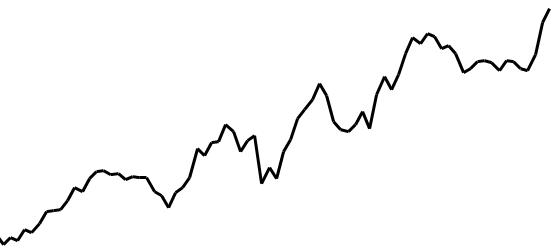
Why line charts matter for traders
Because of this lack of detail, the line chart is of limited use for active traders. Many traders therefore prefer candlestick charts or bar charts, which show all four prices of each period – open, high, low and close – as well as gaps between periods. The line chart's strength lies in its clarity: it filters out intraday fluctuations and makes the big picture easy to see. This makes it useful for getting a quick overview of long-term trends, for comparing several instruments in one chart and for presenting price developments in reports and the media.
Cashback angle
Cashback is paid on every lot you trade – up to $4.40 per lot at RoboForex.
Get deal** Affiliate link (advertising)
More terms.
- Bar chartA bar chart (OHLC chart) shows each period as a vertical bar marking the open, high, low and close, so the full price range of every period is visible.
- Point and figure chartA point and figure chart records only significant price changes, using columns of X's for rising and O's for falling prices; time plays no role.